Predictable throughout the cycle.
The wing must pull effectively during generation, return with low force and behave consistently through steering, launch and recovery.

Designing kites for the energy cycle.
Useful power depends on a wing that can keep working, cycle after cycle.
Kitepower develops airborne wind energy systems that use a tethered kite and a compact ground station to generate renewable electricity. By reaching winds higher above the ground, the concept offers a route to low-carbon power with a small physical footprint.
The engineering challenge combines automated operation with competitive lifetime costs. Kitepower brought its flight-control and system expertise; FAIR AERO contributed specialist wing design, coupled simulation and hands-on test support.
The wing must pull effectively during generation, return with low force and behave consistently through steering, launch and recovery.
To compete with conventional wind and solar, the wing must balance durability, manufacturing and maintenance costs with aerodynamic efficiency.
A shared development loop,
from the numerical wing to the test site.
We worked closely with Kitepower’s team to explore simpler, lighter configurations, including single-skin concepts. Textile selection balanced durability, weight and manufacturing simplicity alongside handling. Particular attention went to seams, reinforcements and attachment points: small construction details become critical as wing size and loads increase.
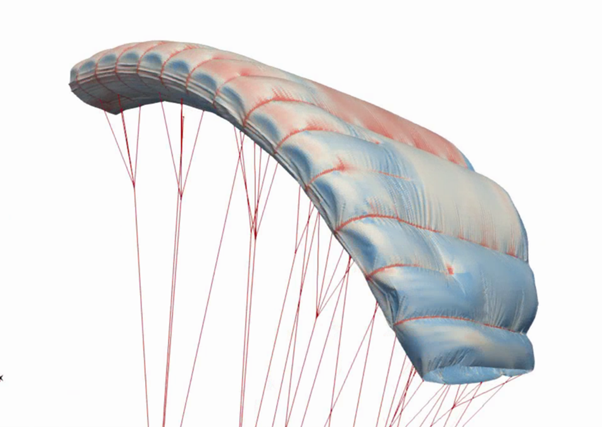
Coupled simulation helped us examine how the wing deforms under aerodynamic loading and how forces travel through the canopy and suspension. We compared design changes, investigated control effort and refined the flying shape and load distribution before taking the next configuration into testing.
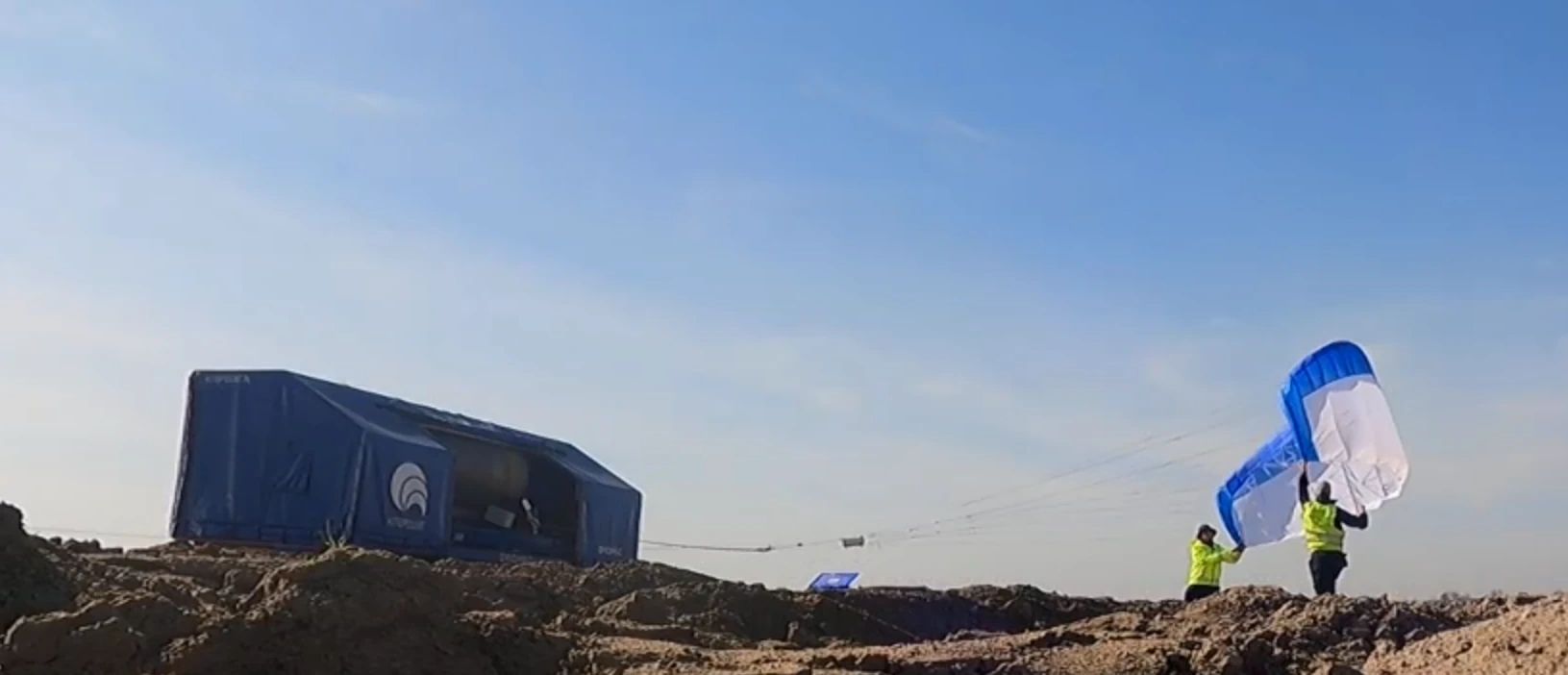
Our contribution continued at Kitepower’s test sites, alongside the operators. From manual handling and trim adjustments to trials with the complete system, field observations informed the next design decision. Working through wet and cold conditions kept the engineering connected to the practical realities of an outdoor energy machine.
“Working with Kitepower, we increased power generation by completely rethinking the kite concept. The resulting wing is up to 60% lighter than previous designs. Improvements in stability eliminated all incidents related to front stalls, while maintaining a very high lift coefficient for power generation.”
Tom Lolies & Corentin Tran — Kite design engineers
Wing preparation & deployment timeReduced by a factor of six.
The value of an energy kite is measured across its working life. FAIR AERO can help bring wing design, durability and automated operation together around the economics of the complete system.
Compare wing architectures, panel layouts and reinforcement choices to reduce manufacturing complexity and cost while meeting the required aerodynamic and structural performance.
Evaluate loads in textiles, seams, reinforcements and attachment points across representative operating cycles. Use the results to guide material and assembly choices and target the durability tests that matter.
Generate aerodynamic and load-response maps for control-system development, tuning and system simulation. Give the autopilot team quantified inputs that reflect how the flexible wing deforms and responds.
Speak directly with the engineers who build the models and test the wings.
What would you like to do?